Faculty of Humanities
Facultyof Humanities
Photo: UHH/Denstorf
5 March 2026, by Zsuzsa Becker
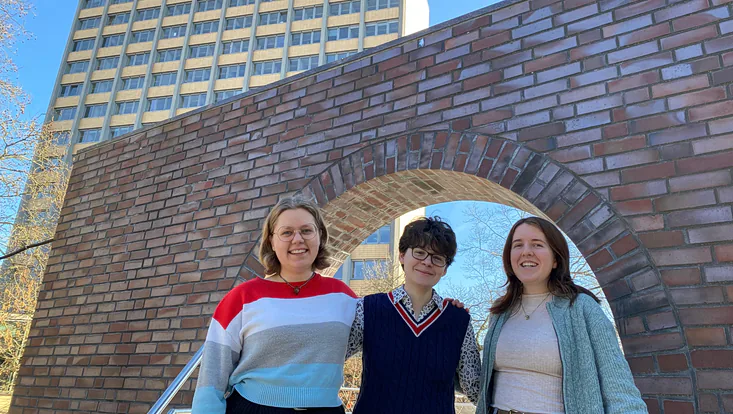
Photo: Isabella Banger
The Older German Language and Literature section of the Institute of German Studies tested a new tutorial concept in the winter semester of 2025/26. What makes it special is that the tutorial is not offered alongside the courses as usual, but is being held for the first time as a block course at the beginning of the semester break. The aim is to give students a focused introduction to academic work and thus improve the quality of their academic performance in the long term. The AStuB and the Writing Center provided didactic support for the project.
Lina Herz: When I started teaching in Hamburg four years ago, I gradually noticed that knowledge of how to work scientifically, develop a research question or thesis, research literature, cite, bibliograph, excerpt, etc. This has nothing to do with a lack of willingness on the part of the students, but is simply due to the fact that there are no (modularized) courses in literary studies that systematically teach these skills. When I was a student, there were still compulsory exercises such as “Introduction to Literary Studies,” which sounds a bit outdated, but served the important purpose of ensuring that students were not alone and could learn to deal with the expectations of how and what to read and write at university. Especially after the pandemic, which led a generation of students to study alone in front of their screens, and with the changed writing conditions brought about by generative AI, the effects of which we are currently experiencing with full force, it seemed important to me to revive this ‘old’ event format – and to actually bring it to life: On site, in person, in a protected space, in peer-to-peer exchange with highly trained tutors who are available as contact persons with all the important information at their fingertips, and at the very moment when the term paper actually ‘happens’. Namely, at the beginning of the semester break, when you're sitting alone in front of your computer, with a lot on your mind and in your notes app, but you don't know exactly how and where to start.
Pia Wennrich: With the first term paper, students face the challenge of completing a new type of exam with numerous unfamiliar rules and working methods. However, a basic introduction to academic work is often neglected during studies—and that's exactly where we wanted to start. The aim is to provide students with a sound basic knowledge, especially for the subject of medical history, which requires working with historical texts. Not only do they receive a wealth of information and tips, but we also work together on examples and their own term paper ideas, which can be developed (further) in the tutorial. The aim is to familiarize students with the exam format so that they can approach their first term paper with confidence and enjoy writing—by students, for students.
Sophie Grimm: During three four-hour block sessions during the semester, we worked with Lenah Grimm (ÄdL) and Nadia Blüthmann (AStuB) to draw up a schedule for the tutorials. We worked out which topics should be covered and received input from Nadia on the didactic approach. During one of the three sessions, we were also accompanied by the Writing Center: Fridrun Freise and Valérie Le Vot provided us with all kinds of knowledge about the writing process and style issues. They gave us a lot of material that we later used in our tutorials. This included, for example, a worksheet on finding topics and research questions. Students were able to fill this out before the tutorial began in order to receive feedback and input from us on their term paper ideas in preparation for a discussion with their lecturers. The Writing Center also provided us with support in giving this feedback in a separate session. Thanks to all this support, we were able to start the tutorials well prepared.
Christina Scherer: The block days are tutorials lasting several hours that cover all topics related to term papers. This includes everything from deciding on a topic and question that really interest me, to structuring my own work, researching literature and sources, to fine-tuning the language and style. There is particularly high demand for research and citation: students know they need secondary literature, but they don't know how to find it. Learning how to cite correctly is central to academic writing and prevents plagiarism. Finally, there is an opportunity to reflect on and optimize one's own writing process. By the end of the course, students should know what they can do to make their writing process more efficient and relaxed.
Lina Herz: I am very pleased about this ‘pilot episode’ of the tutorial for two reasons. Firstly, the UHH has an excellent infrastructure for implementing such projects competently and with low barriers to entry. This made it very easy and possible for everyone involved to draw on the expertise of the AStuB and the Writing Center and to train our tutors in the best possible way. Many thanks for the great cooperation! Secondly, the response and interest from students was so great that we could have offered even more blocks. This speaks volumes and is a wonderful confirmation that we definitely want to expand and further optimize our offerings here. Whether and to what extent this format will be reflected in the results of the seminar papers remains to be seen in the coming months. That is why we will, of course, evaluate this further.
Lenah Grimm: Right at the start of the lecture period, students came to me and showed great interest in the content of the tutorial – the high demand was then also reflected in the registration figures, which rose steadily over the semester. Even during the preparation of term papers in the last few weeks, i.e., finding and agreeing on topics, many students already used the materials from the tutorial/writing center to structure and present their initial thoughts. Seeing how gratefully these offers were accepted made me very happy and encouraged me to continue and expand the project in the coming semesters.
Come to the tutorial, ...
Pia Wennrich: ...if you're having trouble with your first term paper and want to learn and practice how to approach academic writing in a confidential environment!
Sophie Grimm: ...to ask all the questions you've ever had about term papers in an open and non-judgmental space and get answers!
Christina Scherer: ...if term papers stress you out and you want to be more relaxed!
The tutorials on “Introduction to Literary Studies (ÄdSL)” took place in mid-February in three two-day block sessions. The content was designed to introduce and deepen participants' knowledge of the basics of academic writing (research topics, research, argumentation structure, style, citation, bibliography, etc.) in a protected space, and to test and practice these skills using their (first) own term paper.
If you are interested or have any questions, please contact: lenah.grimm"AT"uni-hamburg.de
We would like to expand our offerings in the 2026 summer semester and are therefore looking for new members to join our team of tutors!
Lenah Grimm is a research assistant at the Institute of German Studies. Together with tutors Pia Wennrich (German Literature, M.A.), Sophie-Elisabeth Grimm (German Literature, M.A.) and Christina Scherer (German Literature, M.A.), she carried out the pilot project in Old German Language and Literature. Nadia Blüthmann from the Office for Academic and Career Services provided didactic support for the project. Lina Herz initiated the project and oversaw its conceptual development. She has been a junior professor of late medieval and early modern German literature at the University of Hamburg since 2022.

