
Faculty of Humanities
Facultyof Humanities
Photo: UHH/Denstorf
10 August 2026, by Zsuzsa Becker
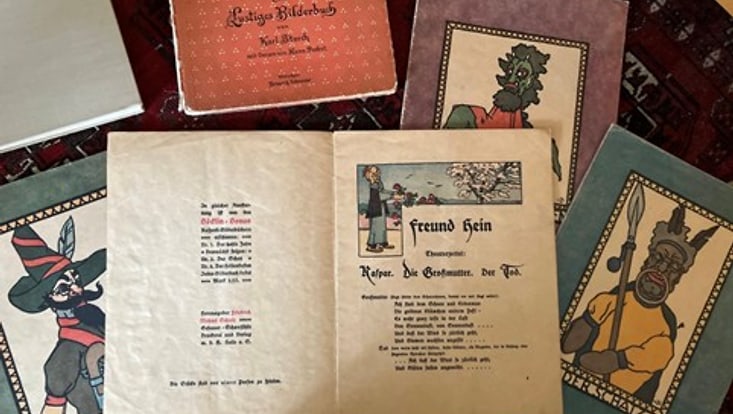
Photo: Nadja Murphy
From the estate of collector Joachim Klinger (1932–2024), his daughters Nadja Murphy and Prof. Dr. Judith Klinger have donated his private collection of picture books and children’s books to the University of Hamburg. The collection, comprising over 60 selected titles, offers a historical insight into roughly half a century of picture book history: from the early 20th century through the late 1960s. Among them are some rare and valuable editions.
Dr. Joachim Klinger (born in Dortmund in 1932, died in Berlin in 2024) held a doctorate in law, served as a film consultant, and was a senior administrative official in the Ministry of Culture of the State of North Rhine-Westphalia. He not only collected books but also wrote and drew himself. As a self-taught painter, draftsman, caricaturist, and illustrator, he published his work with Grupello and as a self-publisher, among others. A significant portion of his artistic estate is now housed at the Wilhelm Fabry Museum in Hilden: approximately 7,000 watercolors, drawings, and caricatures there document the diversity of his work.
The donation to the UHH does not include any of his own works; nevertheless, the artist and illustrator’s keen powers of observation are reflected in his private collection of children’s books. Names such as Carlo Böcklin, Elisabeth Schellbach, Else Wenz-Viëtor, Fritz Baumgarten, Fritz Koch-Gotha, Gertrud Caspari, Hans Bausch, Otto Speckter, Pia Roshardt, and Walter Trier can be found in Klinger’s collection, which was carefully selected and expanded over the course of decades. The collection includes picture books that still contain personal dedications—such as messages from a godfather—to this day. It also includes classics such as Die Häschenschule (1935), Etwas von den Wurzelkindern (1925), and Till Eulenspiegel (1922), as well as numerous illustrated fairy tales by Goethe, Bechstein, Storm, Andersen, and Hauff. This is complemented by multi-volume picture book series featuring Professor Wüsstegern (1940s) by Hilde Bensing and the Kasperl picture books (1911) by Böcklin-Bonus. Rare editions such as Neidteufelchen (1949) by Walther Pollatschek and Dorothea Nosbisch, as well as Firleifanz (1910) by Hans Watzlik and Ernst Kutzer, are also included. Furthermore, the collection now brings together books from various eras and design traditions—including an early edition of Der gestiefelte Kater from 1905. “His collection of children’s books was very dear to him: It was based on his own childhood treasures, but over the years he built up and expanded the collection with a keen interest in the art of illustration,” reports Prof. Dr. Judith Klinger, who herself studied at the UHH.
The collection offers insights into an artist’s personal reading history while also facilitating scholarly examination of the development of illustration, design, and narrative forms in children’s books. Once cataloged, it will be available to students and researchers at the University of Hamburg in the Picture Book Library, opening up new perspectives on the history of the illustrated children’s book. The Picture Book Library is located on the 6th floor of the Library of Humanities. The goal is to highlight the picture book as a literarily and artistically sophisticated medium and to provide students—particularly those training to become teachers—with easy access to it.
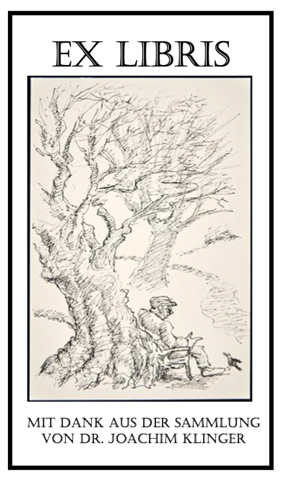
The Library of the Humanities and the Department of Children’s and Youth Media Research, headed by Prof. Dr. Tobias Kurwinkel, would like to thank the donors for their generous gift. As a token of gratitude, a specially designed bookplate was created, featuring a self-portrait of Klinger.
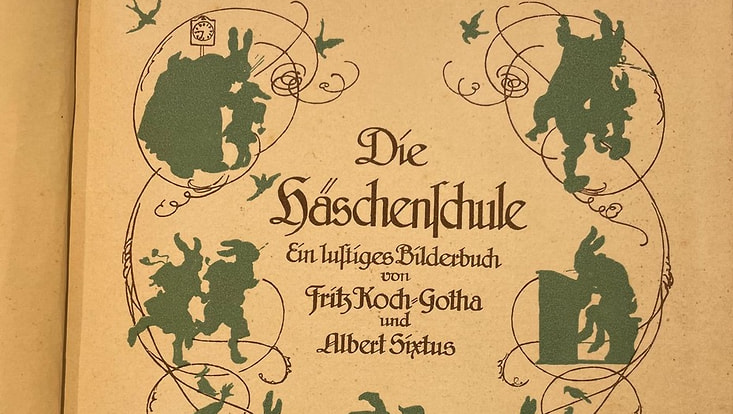
Photo: UHH/Schwarz
Die Häschenschule (1935) mit Versen von Albert Sixtus und Zeichnungen von Fritz Koch-Gotha
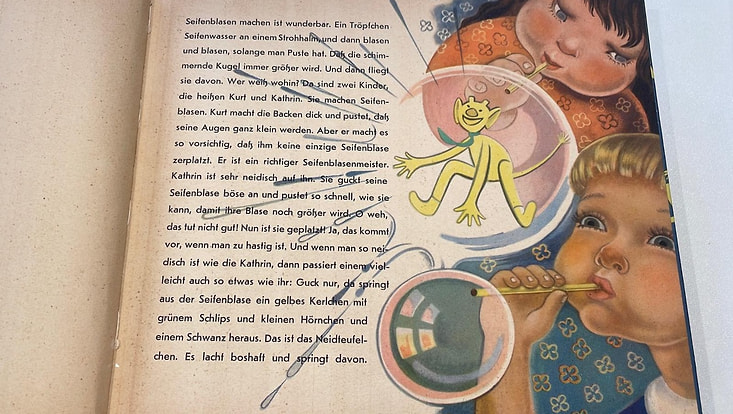
Photo: UHH/Schwarz
Neidteufelchen (1949) von Walther Pollatschek und Dorothea Nosbisch
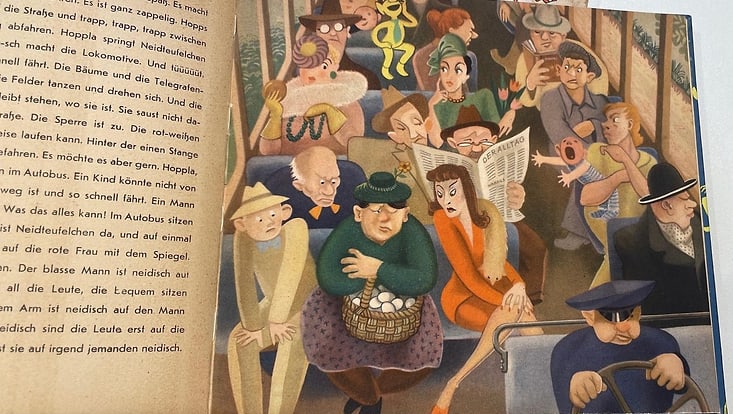
Photo: UHH/Schwarz
Neidteufelchen (1949) von Walther Pollatschek und Dorothea Nosbisch
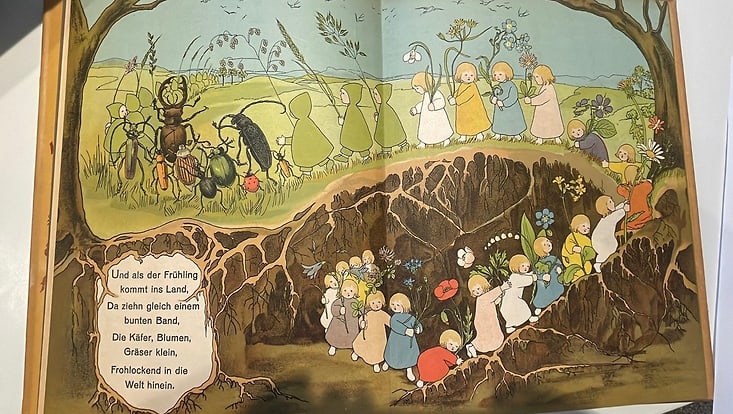
Photo: UHH/Schwarz
Etwas von den Wurzelkindern (1925) von Sibylle von Olfers
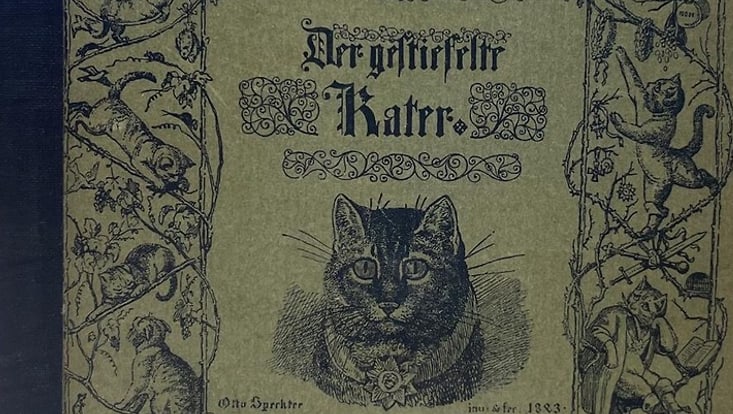
Photo: UHH/Schwarz
Der gestiefelte Kater (1905) mit Illustrationen von Otto Speckter